Note
Go to the end to download the full example code.
Understanding the multiband extension of GEDAI🔗
This tutorial demonstrates how to use multiband GEDAI.
Multiband GEDAI is a frequency-specific denoising method that extends the
generalized eigenvalue decomposition approach of GEDAI.
Its approach focuses on isolating and removing artifacts within specific
frequency bands. For that, the multiband GEDAI first decomposes the EEG
data into its frequency components using wavelet transform, then applies
GEDAI to each frequency band separately. Finally, the denoised frequency
components are recombined to reconstruct the cleaned EEG signal.
Note
The purpose of this tutorial is to explain the different parameters of
the MultibandGedai model and help you better
understand the underlying algorithm. If you want to learn how to use
Multiband GEDAI in a practical, end-to-end offline denoising
workflow, please refer to the
Practical Pipelines section.
%%
import matplotlib.pyplot as plt
from mne.io import read_raw

from gedai import MultibandGedai
from gedai.data import get_contaminated_eeg_set_path
from gedai.viz import plot_mne_style_overlay_interactive

n_jobs = 1
raw = read_raw(str(get_contaminated_eeg_set_path()), preload=True)
For simplicity, we will only use the first 30 seconds of the data in this tutorial. In practice, it is recommended to use the full recording for fitting the GEDAI model, as this allows the model to better capture the noise characteristics of the data.
raw.crop(0, 30)
GEDAI🔗
To use spectral GEDAI, we initialize the
MultibandGedai object. By default, wavelet_level="auto"
automatically determines the number of wavelet levels based on sampling frequency
and the high-pass cutoff.
Broadband Pass (Two-Pass Filtering):🔗
The broadband_pass=True parameter enables
a two-stage hierarchical cleaning workflow:
Pass 1 (Broadband Pass): A full-spectrum spatial GEDAI filter is applied first to clean large, widespread artifacts (e.g. eye blinks, muscular bursts, head motion) across all channels simultaneously. This prevents massive artifacts from leaking across adjacent wavelet frequency subbands.
Pass 2 (Multiband Wavelet Pass): The pre-cleaned signal is decomposed into MODWT wavelet frequency bands, where each subband receives dedicated, fine-grained eigenvalue thresholding tailored to its specific frequency dynamics.
Enabling broadband_pass=True is recommended for recordings with prominent blinks
or muscle contamination.
multiband_gedai = MultibandGedai(
    wavelet_type="haar",
    wavelet_level="auto",
    broadband_pass=True,
)
Model Fitting🔗
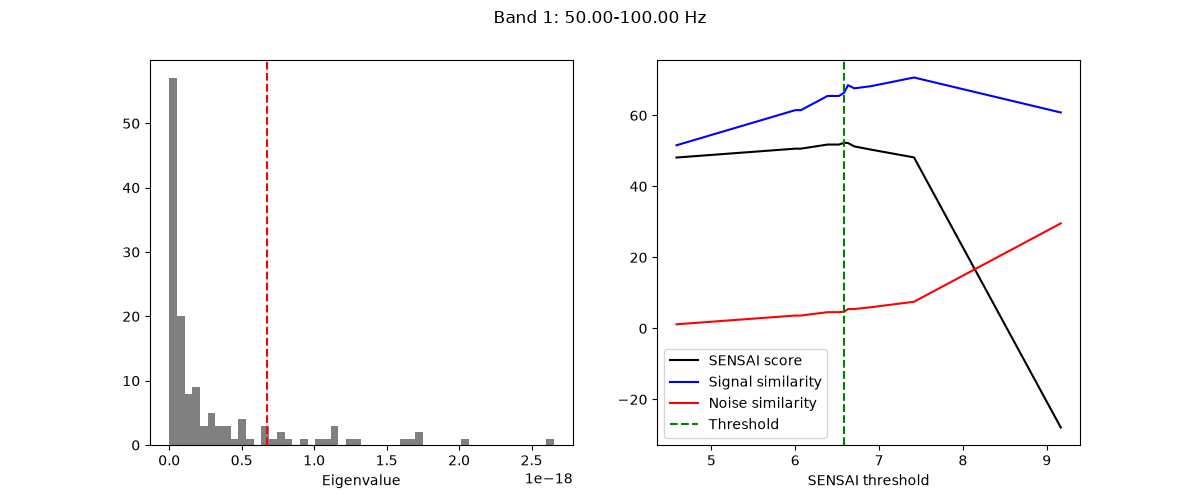
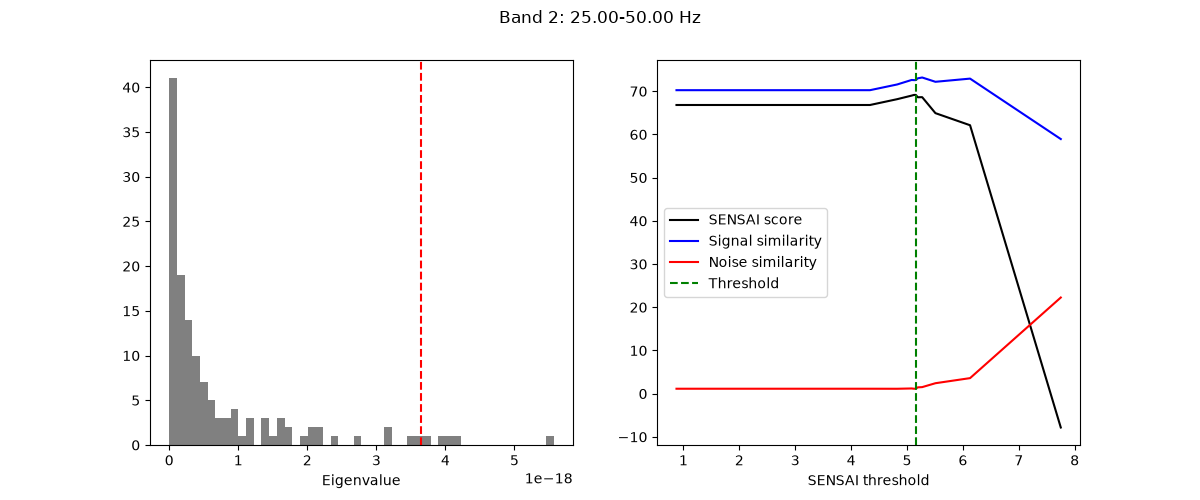
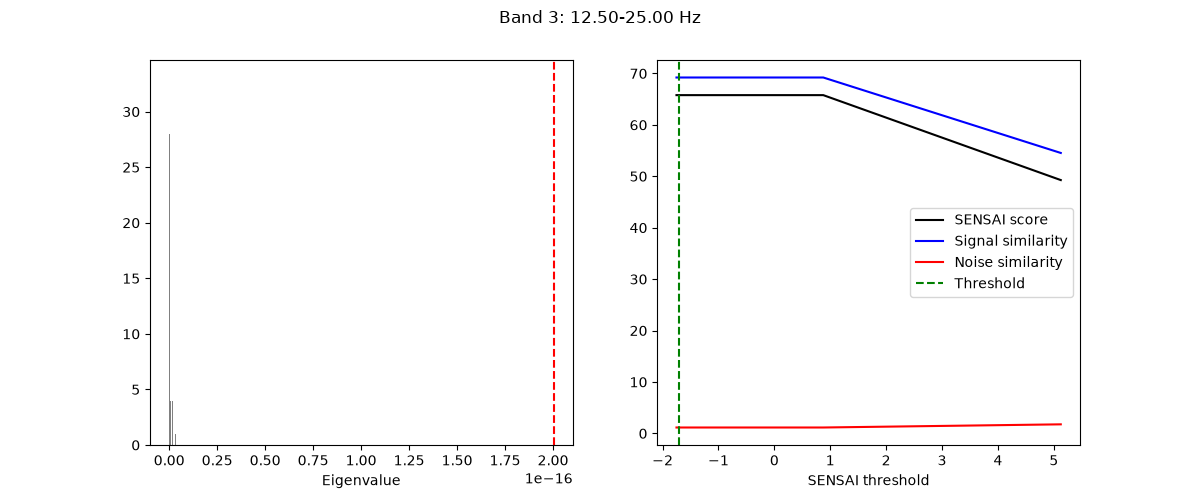
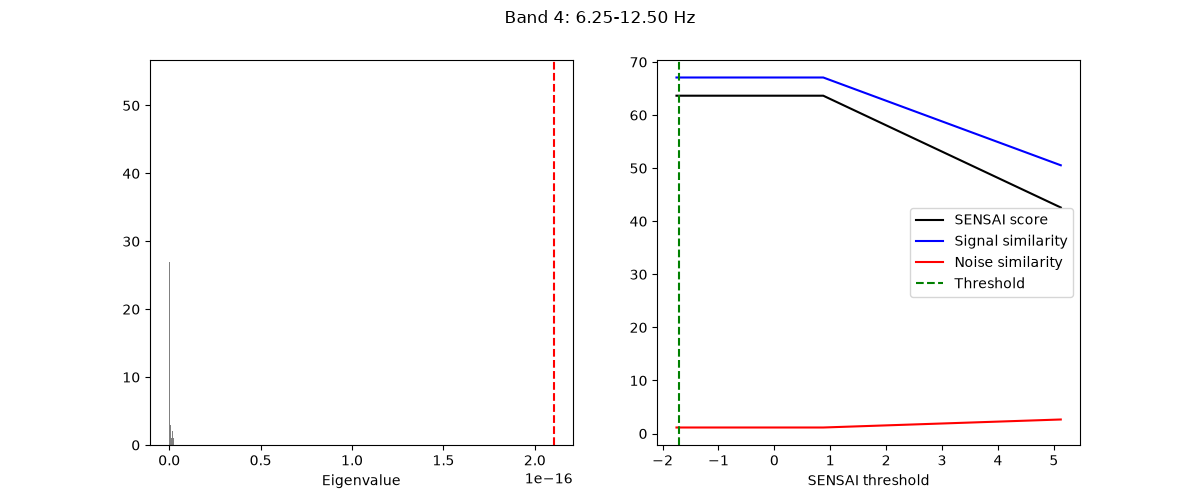
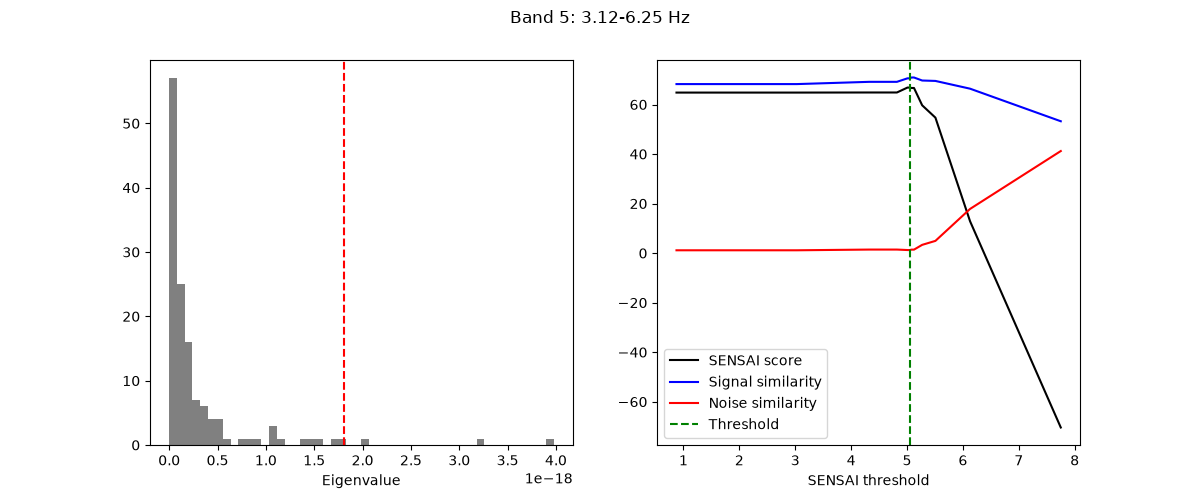
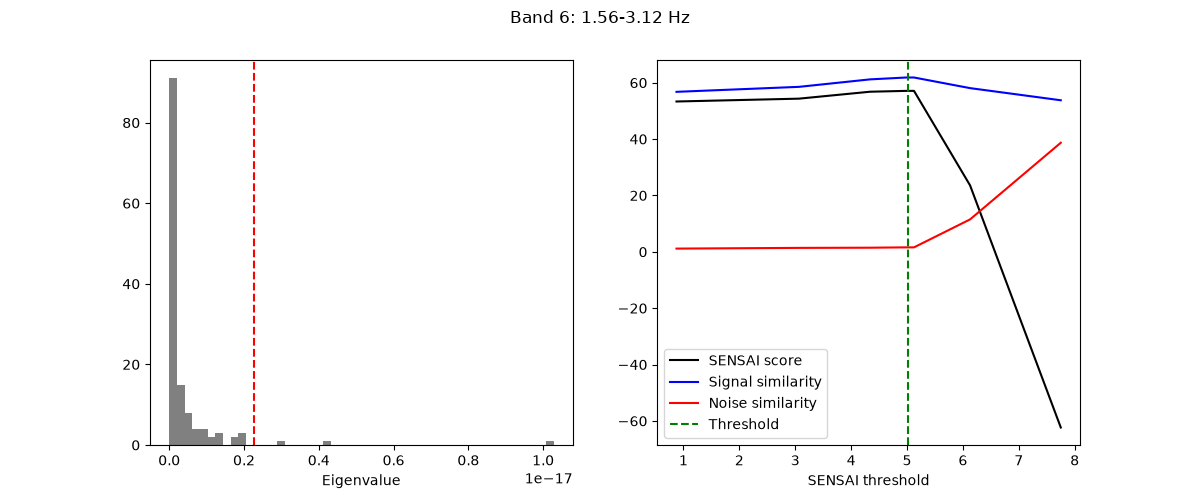
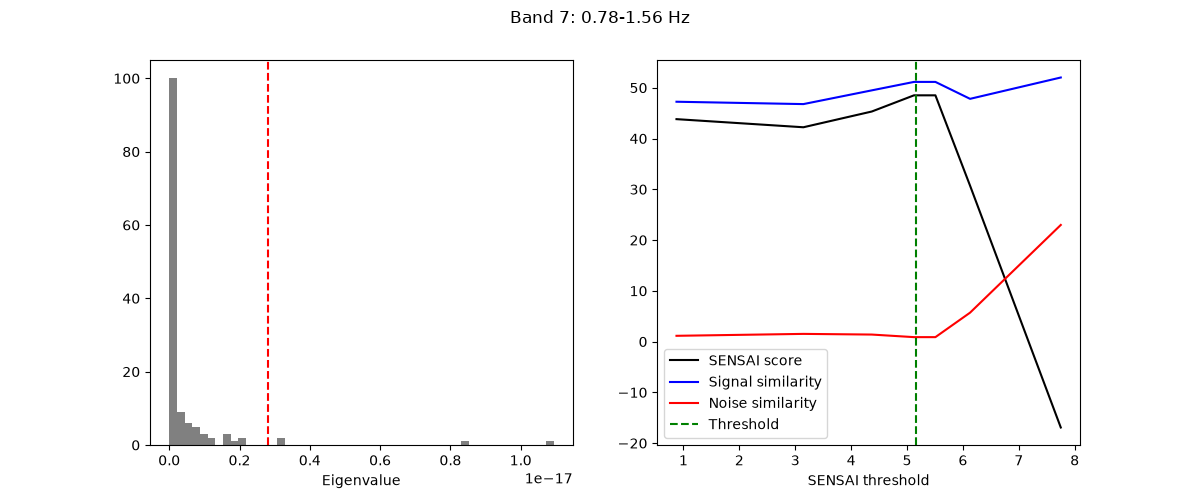
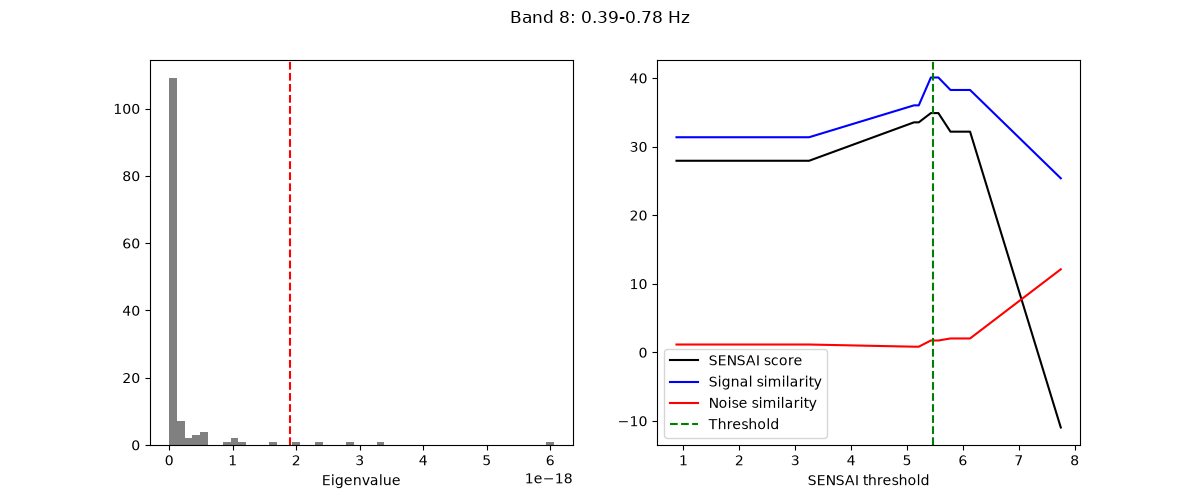
The fitting process of spectral GEDAI is performed for each wavelet level
(i.e., frequency band) to estimate the optimal threshold to distinguish between
signal and noise components using SENSAI optimization (sensai_method="optimize").
multiband_gedai.fit_raw(raw, duration=2.0, n_jobs=n_jobs, verbose=True)
    343 x 343 full covariance (kind = 1) found.
[multiband.fit_raw] WARNING: Requested duration 2.000s adjusted to 5.120s (1024 samples) to satisfy wavelet level 9 requirements.
[multiband.fit_raw] INFO: Applying wavelet HP pre-filter (sub-0.50 Hz) and running broadband GEDAI pass...
Note
Since multiband GEDAI uses spectral decomposition, the fitting
process will automatically adjust the epoch duration to ensure that
each epoch contains a number of samples appropriate for the wavelet
decomposition.
Transform the Data (Denoising)🔗
Once fitted, the Multiband GEDAI model cleans each frequency band using
dual-stream cosine overlap-add blending (with 50% shifted streams) to eliminate
any epoch boundary jump artifacts before recombining them.
denoised_raw = multiband_gedai.transform_raw(raw, n_jobs=n_jobs, verbose=False)
Warning
Since the Multiband GEDAI operates on epoched data internally
during fitting, some frequency content more particularly in lower
frequency bands may be not be captured properly if the
epoch duration is too short.
On the other hand, using very long epochs may prevent capturing short
transient artifacts. Setting the wavelet_low_cutoff parameter to
"auto" or to the acquisition high-pass cutoff excludes
low frequency bands below the signal bandwidth.
plot_mne_style_overlay_interactive(raw, denoised_raw, duration=15.0)
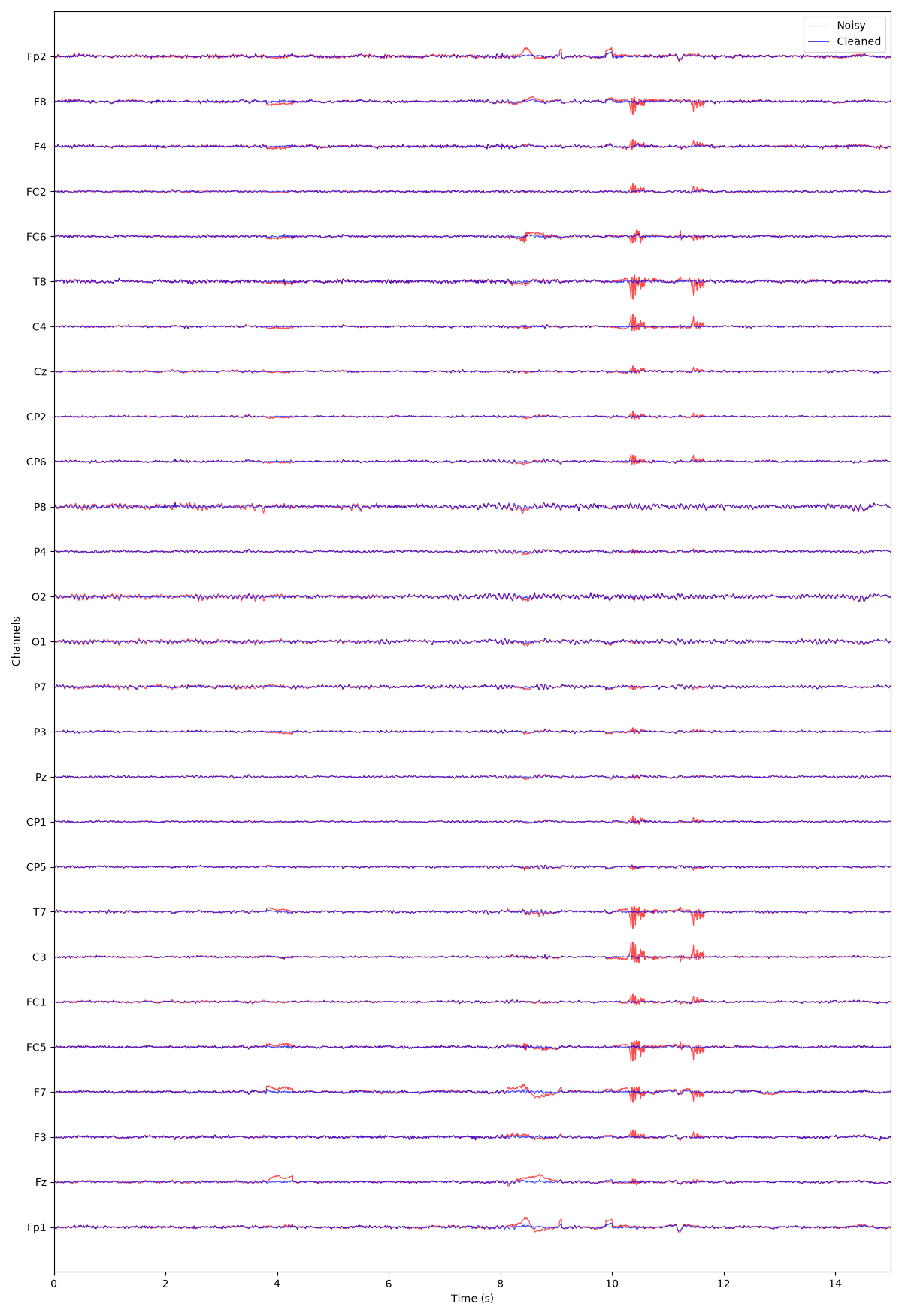
(<Figure size 1200x1750 with 1 Axes>, <Axes: xlabel='Time (s)', ylabel='Channels'>)
Total running time of the script: (0 minutes 6.224 seconds)
Estimated memory usage: 330 MB